Invasive Species
Roads are the primary vector for non-native species introduction into wildlands.
The Threat
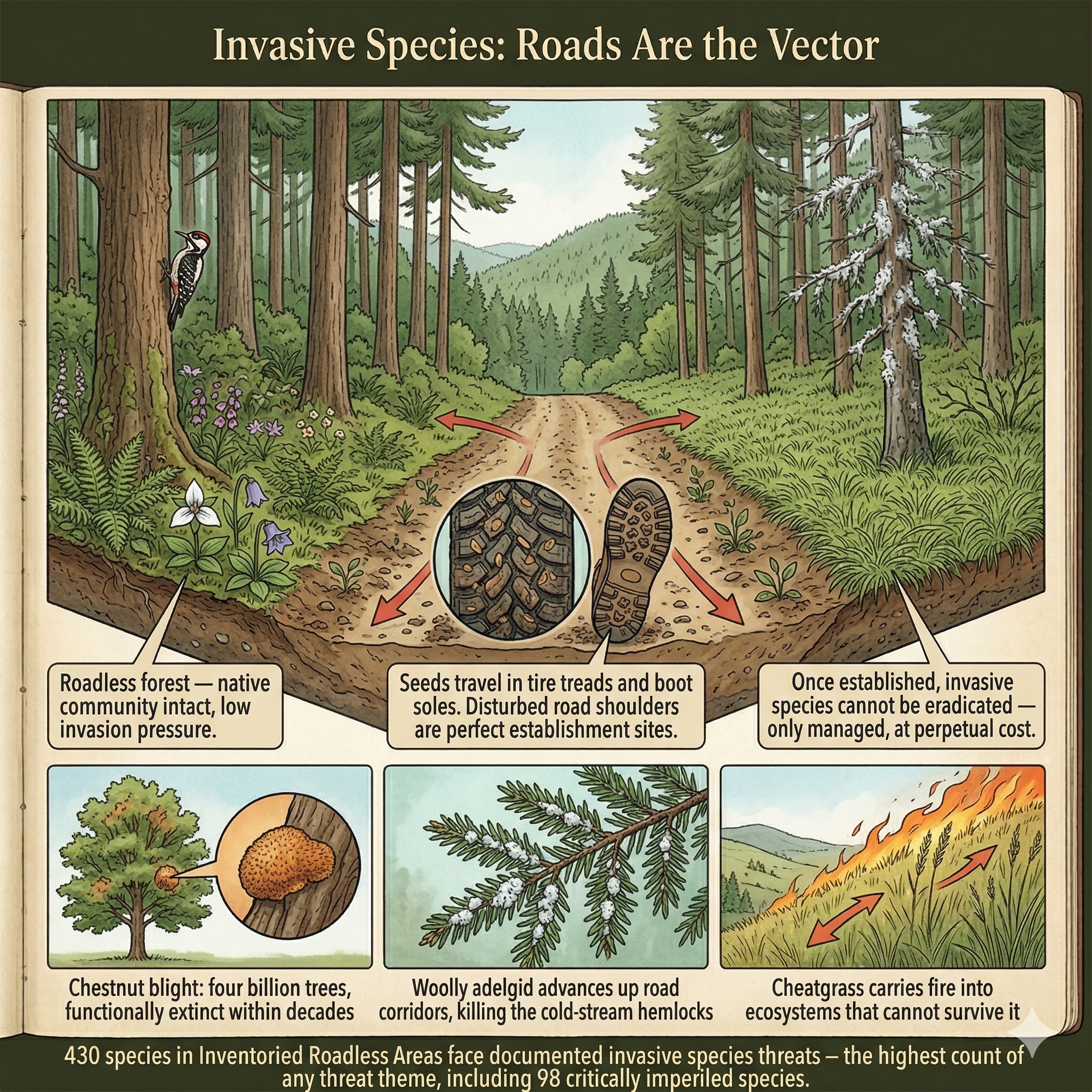
Every invasive species in a wilderness area arrived somehow. It did not materialize. It traveled.
The mechanism is almost insultingly mundane: a seed lodged in a tire tread, shaken loose in a parking lot a hundred miles from where it was collected. Soil carried on a boot sole from an infested trailhead to a clean one. A plant fragment floating in the rinse water from an off-road vehicle. The disturbed ground along a new road shoulder — bare mineral soil, churned and exposed by grading — offers exactly the open, sunlit, low-competition conditions in which invasive plants establish most readily. The road does not need to bring invasive species intentionally. It simply needs to exist, and to be used.
The consequences can be permanent. Invasive plants restructure the forest floor, outcompeting the native wildflowers and ferns that many animals depend on for food and cover. Some — like Japanese stiltgrass in the East, or cheatgrass in the West — alter fire regimes, carrying flames into ecosystems that evolved without them and burning with an intensity and frequency that native plants cannot withstand. Invasive pathogens can eliminate entire tree species: the American chestnut gone from four billion individuals to functionally extinct within a human lifetime. Hemlock woolly adelgid advancing up Appalachian drainages, killing the eastern hemlock that creates the cold, shaded, spring-fed streams that species like the Hellbender depend on.
Roadless areas are not sterile. Invasive species are already present in some. But they are measurably less invaded than roaded landscapes. The official definition of 8.1 Invasive Non-Native / Alien Species covers "harmful plants, animals, and other species not originally found within the ecosystem(s) in question and directly or indirectly introduced and spread into it by human activities." Its exposition notes that climate change complicates the definition — as ecosystems shift, determining what is "native" requires judgment. But for the vast majority of invasive threats documented in this database, the source is unambiguous: human movement through the landscape, on roads.
NatureServe's own ecosystem data makes the scale visible: 197 of the 231 ecosystem threat narratives in this database — 85 percent — specifically name invasive species as a documented threat.
In the roadless areas covered by this application: 430 species carry documented invasive species threats — the highest count of any threat theme. This includes 98 critically imperiled and 105 imperiled species. For many, the arrival of a single invasive competitor or pathogen into currently uninvaded habitat could be the event that ends local populations that have persisted for millennia.
Roads are the primary vector. Disturbed soils create establishment sites. Vehicle and foot traffic continuously introduce propagules. Roadless areas have measurably fewer invasive populations because the introduction pathway does not exist.
Severity of Impact
NatureServe rates the expected population decline for each species facing this threat, using the IUCN-CMP international standard.
Species at Risk
Imperiled species (G1-G3 or federally listed) with NatureServe-assessed threat records in this category. Sort and filter to explore.
| Species | Rank | ESA | Threat | Severity ▲ | Scope | Areas |
|---|---|---|---|---|---|---|
| Big Creek Crayfish Faxonius peruncus | G1 | T | 8.1 Invasive non-native/alien species/diseases | Extreme or 71-100% pop. decline | Pervasive - large | 1 |
| Chihuahua Chub Gila nigrescens | G1 | T | 8.1 Invasive non-native/alien species/diseases | Extreme - moderate | Pervasive - restricted | 3 |
| Clover Valley Speckled Dace Rhinichthys osculus oligoporus | T1 | E | 8.1 Invasive non-native/alien species/diseases | Extreme - moderate | Pervasive - large | 11 |
| Contra Costa Goldfields Lasthenia conjugens | G1 | E | 8.1 Invasive non-native/alien species/diseases | Extreme - moderate | Pervasive - restricted | 7 |
| Desert Dace Eremichthys acros | G1 | T | 8.1 Invasive non-native/alien species/diseases | Extreme - moderate | Pervasive (71-100%) | 1 |
| Desert Pupfish Cyprinodon macularius | G1 | E | 8.1 Invasive non-native/alien species/diseases | Extreme - moderate | Pervasive (71-100%) | 8 |
| Devil's Hole Pupfish Cyprinodon diabolis | G1 | E | 8.1 Invasive non-native/alien species/diseases | Extreme - moderate | Pervasive (71-100%) | 15 |
| Hiko White River Springfish Crenichthys baileyi grandis | T1 | E | 8.1 Invasive non-native/alien species/diseases | Extreme - moderate | Large (31-70%) | 17 |
| Applegate's Milkvetch Astragalus applegatei | G1 | E | 8.1 Invasive non-native/alien species/diseases | Extreme - serious | Pervasive (71-100%) | 1 |
| Ash Grey Indian-paintbrush Castilleja cinerea | G1 | T | 8.1 Invasive non-native/alien species/diseases | Extreme - serious | Pervasive - large | 5 |
| Bonytail Gila elegans | G1 | E | 8.1 Invasive non-native/alien species/diseases | Extreme - serious | Pervasive (71-100%) | 101 |
| Burke's Goldfields Lasthenia burkei | G1 | E | 8.1 Invasive non-native/alien species/diseases | Extreme - serious | Pervasive - large | 7 |
| Colorado Pikeminnow Ptychocheilus lucius | G1 | E, XN | 8.1 Invasive non-native/alien species/diseases | Extreme - serious | Pervasive (71-100%) | 101 |
| Florida Torreya Torreya taxifolia | G1 | E | 8.1 Invasive non-native/alien species/diseases | Extreme - serious | Pervasive - large | 1 |
| Glowing Indian-paintbrush Castilleja ornata | G1 | E | 8.1 Invasive non-native/alien species/diseases | Extreme - serious | Pervasive (71-100%) | 1 |
| Fanshell Cyprogenia stegaria | G1 | E, XN | 8.1 Invasive non-native/alien species/diseases | Serious or 31-70% pop. decline | Large (31-70%) | 3 |
| Fassett's Locoweed Oxytropis campestris var. chartacea | T1 | T | 8.1 Invasive non-native/alien species/diseases | Serious or 31-70% pop. decline | Pervasive - large | 1 |
| Franklin Bumble Bee Bombus franklini | G1 | E | 8.1 Invasive non-native/alien species/diseases | Serious or 31-70% pop. decline | Pervasive - large | 75 |
| Gray's Lily Lilium grayi | G1 | 8.1 Invasive non-native/alien species/diseases | Serious or 31-70% pop. decline | Pervasive (71-100%) | 10 | |
| Green's Awnless Orcutt Grass Tuctoria greenei | G1 | E | 8.1 Invasive non-native/alien species/diseases | Serious or 31-70% pop. decline | Large - restricted | 25 |
| Black-footed Ferret Mustela nigripes | G1 | E, XN | 8.1 Invasive non-native/alien species/diseases | Serious - moderate | Pervasive - restricted | 3 |
| Clay Phacelia Phacelia argillacea | G1 | E | 8.1 Invasive non-native/alien species/diseases | Serious - moderate | Pervasive (71-100%) | 11 |
| Georgia Rockcress Arabis georgiana | G1 | T | 8.1 Invasive non-native/alien species/diseases | Serious - moderate | Pervasive (71-100%) | 3 |
| Bliss Rapids Snail Taylorconcha serpenticola | G1 | T | 8.1 Invasive non-native/alien species/diseases | Serious - slight | Large - restricted | 1 |
| Blunt-nosed Leopard Lizard Gambelia sila | G1 | E | 8.1 Invasive non-native/alien species/diseases | Serious - slight | Large - small | 1 |
| Bruneau Hot Springsnail Pyrgulopsis bruneauensis | G1 | E | 8.1 Invasive non-native/alien species/diseases | Serious - slight | Large - restricted | 22 |
| Chipola Slabshell Elliptio chipolaensis | G1 | T, PDL | 8.1 Invasive non-native/alien species/diseases | Serious - slight | Restricted (11-30%) | 1 |
| Agate Desert Lomatium Lomatium cookii | G1 | E | 8.1 Invasive non-native/alien species/diseases | Moderate or 11-30% pop. decline | Large - restricted | 1 |
| Arroyo Chub Gila orcuttii | G1 | 8.1 Invasive non-native/alien species/diseases | Moderate or 11-30% pop. decline | Large (31-70%) | 13 | |
| Arroyo Toad Anaxyrus californicus | G1 | E | 8.1 Invasive non-native/alien species/diseases | Moderate or 11-30% pop. decline | Pervasive - large | 49 |
| Barneby's Clover Trifolium barnebyi | G1 | 8.1 Invasive non-native/alien species/diseases | Moderate or 11-30% pop. decline | Restricted - small | 1 | |
| Bear Valley Sandwort Eremogone ursina | G1 | T | 8.1 Invasive non-native/alien species/diseases | Moderate or 11-30% pop. decline | Large (31-70%) | 2 |
| Buck Creek Ragwort Packera serpenticola | G1 | 8.1.1 Unspecified species | Moderate or 11-30% pop. decline | Large (31-70%) | 3 | |
| California Dandelion Taraxacum californicum | G1 | E | 8.1.1 Unspecified species | Moderate or 11-30% pop. decline | Pervasive (71-100%) | 2 |
| California Jewelflower Caulanthus californicus | G1 | E | 8.1 Invasive non-native/alien species/diseases | Moderate or 11-30% pop. decline | Large - restricted | 14 |
| Clubshell Pleurobema clava | G1 | E, XN | 8.1 Invasive non-native/alien species/diseases | Moderate or 11-30% pop. decline | Restricted (11-30%) | 2 |
| Dwarf Bear-poppy Arctomecon humilis | G1 | E | 8.1 Invasive non-native/alien species/diseases | Moderate or 11-30% pop. decline | Restricted (11-30%) | 2 |
| Encinitis Baccharis Baccharis vanessae | G1 | T | 8.1 Invasive non-native/alien species/diseases | Moderate or 11-30% pop. decline | Pervasive - large | 2 |
| Hawaiian Petrel Pterodroma sandwichensis | G1 | E | 8.1 Invasive non-native/alien species/diseases | Moderate or 11-30% pop. decline | Pervasive - large | 4 |
| Holy Ghost Ipomopsis Ipomopsis sancti-spiritus | G1 | E | 8.1 Invasive non-native/alien species/diseases | Moderate or 11-30% pop. decline | Large - restricted | 14 |
| Elusive Jacob's-ladder Polemonium elusum | G1 | 8.1 Invasive non-native/alien species/diseases | Moderate - slight | Restricted (11-30%) | 1 | |
| Giant Kangaroo Rat Dipodomys ingens | G1 | E | 8.1 Invasive non-native/alien species/diseases | Moderate - slight | Unknown | 15 |
Townsendia lemhiensis | G1 | 8.1 Invasive non-native/alien species/diseases | Slight or 1-10% pop. decline | Negligible (<1%) | 3 | |
| Cushion Bladderpod Physaria pulvinata | G1 | 8.1 Invasive non-native/alien species/diseases | Slight or 1-10% pop. decline | Large (31-70%) | 1 | |
| Eastern Black Rail Laterallus jamaicensis jamaicensis | T1 | T | 8.1 Invasive non-native/alien species/diseases | Negligible or <1% pop. decline | Small (1-10%) | 29 |
| Fat Threeridge Amblema neislerii | G1 | E, PDL | 8.1 Invasive non-native/alien species/diseases | Slight or 1-10% pop. decline | Restricted (11-30%) | 1 |
| Banbury Springs Limpet Idaholanx fresti | G1 | E | 8.1 Invasive non-native/alien species/diseases | Unknown | Pervasive (71-100%) | 1 |
| Black Toad Anaxyrus exsul | G1 | 8.1 Invasive non-native/alien species/diseases | — | — | 6 | |
| Carson Wandering Skipper Pseudocopaeodes eunus obscurus | T1 | E | 8.1 Invasive non-native/alien species/diseases | Unknown | Large - restricted | 8 |
| Desert Yellowhead Yermo xanthocephalus | G1 | T | 8.1 Invasive non-native/alien species/diseases | Unknown | Unknown | 2 |
Showing top 50 species. Use filters above to narrow results.
Areas at Risk
Roadless areas where imperiled species face this threat, grouped by state.
Arizona (5)
| Area | Forest | Acres | Species at Risk |
|---|---|---|---|
| Tumacacori | Coronado National Forest | 44,594 | 14 |
| Lower San Francisco | Apache-Sitgreaves National Forests | 59,310 | 13 |
| Mazatzal | Tonto National Forest | 16,942 | 13 |
| Galiuro | Coronado National Forest | 28,333 | 11 |
| Hackberry | Coconino National Forest | 17,885 | 10 |
Arkansas (1)
| Area | Forest | Acres | Species at Risk |
|---|---|---|---|
| Clifty Canyon | Ozark-St. Francis National Forest | 1,963 | 11 |
California (19)
| Area | Forest | Acres | Species at Risk |
|---|---|---|---|
| Wildhorse | Cleveland National Forest | 1,483 | 16 |
| Trabuco | Cleveland National Forest | 23,341 | 15 |
| White Ledge | Los Padres National Forest | 18,632 | 13 |
| Coldwater | Cleveland National Forest | 8,402 | 12 |
| Fox Mountain | Los Padres National Forest | 52,072 | 12 |
| Juncal | Los Padres National Forest | 12,289 | 12 |
| Sespe - Frazier | Los Padres National Forest | 106,910 | 12 |
| Matilija | Los Padres National Forest | 5,218 | 11 |
| Red Mountain | Angeles National Forest | 8,034 | 11 |
| Sawmill - Badlands | Los Padres National Forest | 51,362 | 11 |
| Wonoga Pk. | Inyo National Forest | 11,272 | 11 |
| Antimony | Los Padres National Forest | 40,911 | 10 |
| Condor Point | Los Padres National Forest | 14,897 | 10 |
| Garcia Mountain | Los Padres National Forest | 7,850 | 10 |
| Glass Mountain | Inyo National Forest | 52,867 | 10 |
| Greenhorn Creek | Sequoia National Forest | 28,226 | 10 |
| La Brea | Los Padres National Forest | 14,031 | 10 |
| Magic Mountain | Angeles National Forest | 15,542 | 10 |
| North Lake | Inyo National Forest | 2,406 | 10 |
Colorado (1)
| Area | Forest | Acres | Species at Risk |
|---|---|---|---|
| Dome Peak | Routt NF | 35,716 | 12 |
Florida (1)
| Area | Forest | Acres | Species at Risk |
|---|---|---|---|
| Savannah | Apalachicola National Forest | 1,927 | 15 |
Georgia (1)
| Area | Forest | Acres | Species at Risk |
|---|---|---|---|
| Sarah's Creek | Chattahoochee National Forest | 6,888 | 10 |
Idaho (1)
| Area | Forest | Acres | Species at Risk |
|---|---|---|---|
| Bear Creek | Caribou-Targhee National Forest | 118,582 | 35 |
New Mexico (4)
| Area | Forest | Acres | Species at Risk |
|---|---|---|---|
| Lower San Francisco | Gila National Forest | 26,460 | 12 |
| 1978 Administratively Endorsed Wilderness Proposal | Gila National Forest | 4,286 | 11 |
| Contiguous To Black & Aldo Leopold Wilderness | Gila National Forest | 111,883 | 10 |
| Contiguous To Gila Wilderness & Primitive Area | Gila National Forest | 79,049 | 10 |
North Carolina (13)
| Area | Forest | Acres | Species at Risk |
|---|---|---|---|
| Bearwallow | Pisgah National Forest | 4,113 | 14 |
| Graveyard Ridge (addition) | Pisgah National Forest | 1,958 | 13 |
| Laurel Mountain | Pisgah National Forest | 5,683 | 13 |
| Chunky Gal (addition) | Nantahala National Forest | 3,336 | 12 |
| Balsam Cone | Pisgah National Forest | 10,591 | 11 |
| Jarrett Creek | Pisgah National Forest | 7,485 | 11 |
| Sam Knob (addition) | Pisgah National Forest | 2,576 | 11 |
| South Mills River | Pisgah National Forest | 8,588 | 11 |
| Tusquitee Bald | Nantahala National Forest | 13,670 | 11 |
| Boteler Peak | Nantahala National Forest | 4,205 | 10 |
| Harper Creek | Pisgah National Forest | 7,325 | 10 |
| Overflow Creek | Nantahala National Forest | 3,379 | 10 |
| Snowbird | Nantahala National Forest | 8,489 | 10 |
South Dakota (1)
| Area | Forest | Acres | Species at Risk |
|---|---|---|---|
| Indian Creek | Buffalo Gap National Grassland | 24,666 | 63 |
Tennessee (1)
| Area | Forest | Acres | Species at Risk |
|---|---|---|---|
| Brushy Ridge | Cherokee National Forest | 7,469 | 10 |
Texas (1)
| Area | Forest | Acres | Species at Risk |
|---|---|---|---|
| Big Creek | National Forests in Texas | 1,447 | 18 |
Utah (1)
| Area | Forest | Acres | Species at Risk |
|---|---|---|---|
| 0419020 | Ashley National Forest | 355,684 | 10 |
IUCN Threat Classification
Official definitions from the IUCN-CMP Unified Classification of Direct Threats.
8.1 — Invasive Non-Native / Alien Species (v4.0)
Co-occurring Threats
Roads rarely cause a single type of harm. This threat frequently co-occurs with:
Data Sources
- NatureServe Explorer: species threat assessments using IUCN-CMP v3.2
- IUCN-CMP Threat Category 8.1
- NatureServe ecosystem threat narratives (231 assessed ecosystem types)
- IUCN-CMP v4.0: Salafsky et al., Conservation Biology, 2025
Invasive Species