Logging & Timber Harvest
Commercial timber extraction is economically infeasible without road access.
The Threat
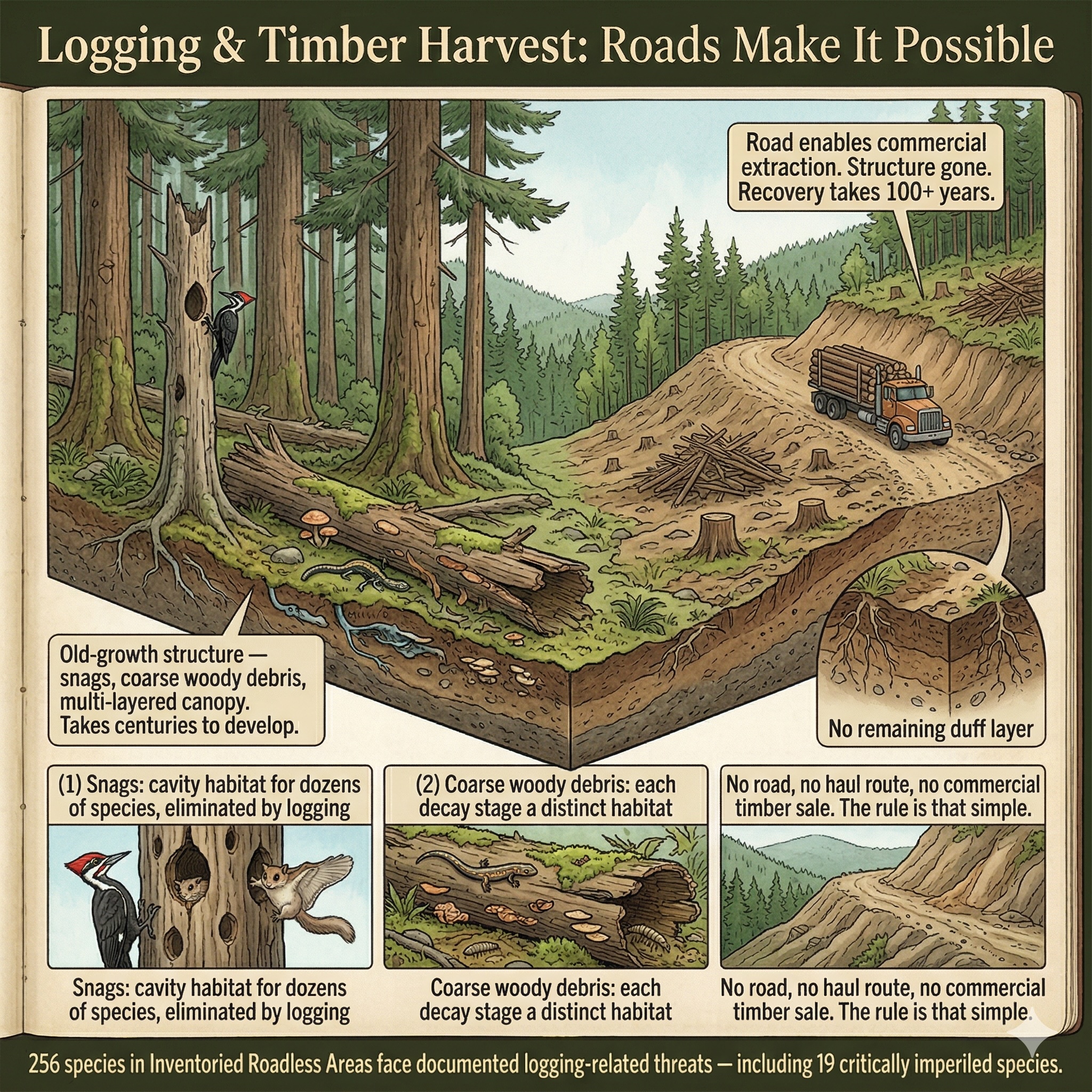
The Roadless Rule's most immediate practical effect has never been philosophical. It has been financial.
No timber company hauls logs out of a roadless forest. Without a road, there is no haul route. Without a haul route, there is no commercial timber sale. The rule does not prohibit logging because it objects to trees being cut. It prohibits roads — and in doing so, it makes commercial logging in these areas economically impossible.
Rescind the rule, and the economics change. Roads become permissible. Timber sales become viable. The sequence that has played out across millions of acres of previously wild national forest — road, then logging, then the compounding consequences of both — becomes available to apply to what remains.
Old forests are not simply large trees. They are structures. A forest that has never been commercially logged has standing dead trees — snags — riddled with cavities that Pileated Woodpeckers excavate and that dozens of other species subsequently inhabit. It has coarse woody debris on the floor — fallen logs in various states of decay, each stage a distinct habitat for different fungi, invertebrates, salamanders, and mosses. It has multi-layered canopy with gaps of different sizes and ages, each supporting different communities of plants and animals. Commercial logging removes not just the timber but the structure — and structure, once removed, takes a century or more to return.
The official definition of code 5.3 Logging, Harvesting & Controlling Trees encompasses "harvesting trees and other woody vegetation for timber, fiber, or fuel, including site preparation and other forestry management practices." Its exposition distinguishes timber operations in natural forests from plantations — the species in this database are threatened by the former.
In the roadless areas covered by this application: 256 species carry documented logging-related threats — including 19 critically imperiled and 46 imperiled species. For these organisms, the old-growth structural features that logging removes are not aesthetic preferences. They are the habitat those species require to survive.
No road means no haul route means no commercial timber extraction. Road construction is the prerequisite that makes logging economically feasible in these areas.
Severity of Impact
NatureServe rates the expected population decline for each species facing this threat, using the IUCN-CMP international standard.
Species at Risk
Imperiled species (G1-G3 or federally listed) with NatureServe-assessed threat records in this category. Sort and filter to explore.
| Species | Rank | ESA | Threat | Severity ▲ | Scope | Areas |
|---|---|---|---|---|---|---|
| Frosted Flatwoods Salamander Ambystoma cingulatum | G1 | T | 5.3 Logging & wood harvesting | Extreme - moderate | Large (31-70%) | 4 |
| Indiana Myotis Myotis sodalis | G2 | E | 5.3 Logging & wood harvesting | Extreme or 71-100% pop. decline | Small (1-10%) | 165 |
| Ash Grey Indian-paintbrush Castilleja cinerea | G1 | T | 5.3 Logging & wood harvesting | Extreme - serious | Pervasive - large | 5 |
| Florida Torreya Torreya taxifolia | G1 | E | 5.3 Logging & wood harvesting | Extreme - serious | Pervasive - large | 1 |
| Wayne's Warbler Setophaga virens waynei | T1 | 5.3 Logging & wood harvesting | Extreme - serious | Pervasive (71-100%) | 7 | |
| Eastern Indigo Snake Drymarchon couperi | G2 | T | 5.3.4 Unintentional effects: large scale (species being assessed is not the target) [harvest] | Extreme - serious | Small (1-10%) | 9 |
| Sacramento Mountains Thistle Cirsium vinaceum | G1 | T | 5.3 Logging & wood harvesting | Serious or 31-70% pop. decline | Pervasive - large | 7 |
| Yreka Phlox Phlox hirsuta | G1 | E | 5.3 Logging & wood harvesting | Serious or 31-70% pop. decline | Large - restricted | 7 |
| Bunched Arrowhead Sagittaria fasciculata | G2 | E | 5.3 Logging & wood harvesting | Serious or 31-70% pop. decline | Pervasive - large | 1 |
| Daubenmire's Dasynotus Dasynotus daubenmirei | G2 | 5.3 Logging & wood harvesting | Serious or 31-70% pop. decline | Large - restricted | 1 | |
| Larch Mountain Salamander Plethodon larselli | G2 | 5.3 Logging & wood harvesting | Serious or 31-70% pop. decline | Large - restricted | 5 | |
| Cheat Mountain Salamander Plethodon nettingi | G1 | T | 5.3 Logging & wood harvesting | Serious - moderate | Restricted (11-30%) | 7 |
| Georgia Rockcress Arabis georgiana | G1 | T | 5.3 Logging & wood harvesting | Serious - moderate | Pervasive (71-100%) | 3 |
| Ozark Hellbender Cryptobranchus alleganiensis bishopi | T1 | E | 5.3 Logging & wood harvesting | Serious - moderate | Large - restricted | 3 |
| Big Levels Salamander Plethodon sherando | G2 | 5.3 Logging & wood harvesting | Serious - moderate | Pervasive - large | 5 | |
| Caddo Mountain Salamander Plethodon caddoensis | G2 | 5.3 Logging & wood harvesting | Serious - moderate | Restricted - small | 1 | |
| California Spotted Owl Strix occidentalis occidentalis | T2 | 5.3 Logging & wood harvesting | Serious - moderate | Pervasive - restricted | 164 | |
| Carolina Northern Flying Squirrel Glaucomys sabrinus coloratus | T2 | E | 5.3 Logging & wood harvesting | Serious - moderate | Pervasive - restricted | 26 |
| Fourche Mountain Salamander Plethodon fourchensis | G2 | 5.3 Logging & wood harvesting | Serious - moderate | Restricted (11-30%) | 1 | |
| Kiamichi Slimy Salamander Plethodon kiamichi | G2 | 5.3 Logging & wood harvesting | Serious - moderate | Pervasive (71-100%) | 1 | |
| Holmgren's Bittercress Cardamine holmgrenii | G1 | 5.3 Logging & wood harvesting | Serious - slight | Large - restricted | 1 | |
| Louisiana Pigtoe Pleurobema riddellii | G1 | PT | 5.3 Logging & wood harvesting | Serious - slight | Restricted (11-30%) | 3 |
| Florida Scrub Lizard Sceloporus woodi | G2 | UR | 5.3 Logging & wood harvesting | Serious - slight | Large - restricted | 1 |
| Benton County Cave Crayfish Cambarus aculabrum | G1 | E | 5.3 Logging & wood harvesting | Moderate or 11-30% pop. decline | Small (1-10%) | 1 |
| Gila Morning Glory Ipomoea gilana | G1 | 5.3 Logging & wood harvesting | Moderate or 11-30% pop. decline | Restricted (11-30%) | 2 | |
| Soapwort Gentian Gentiana latidens | G1 | 5.3 Logging & wood harvesting | Moderate or 11-30% pop. decline | Small (1-10%) | 2 | |
| Wanatchee Mountains Checker-mallow Sidalcea oregana var. calva | T1 | E | 5.3 Logging & wood harvesting | Moderate or 11-30% pop. decline | Restricted (11-30%) | 4 |
| Bolander's Woodreed Cinna bolanderi | G2 | 5.3 Logging & wood harvesting | Moderate or 11-30% pop. decline | Restricted (11-30%) | 5 | |
| Florida Skullcap Scutellaria floridana | G2 | T | 5.3 Logging & wood harvesting | Moderate or 11-30% pop. decline | Large (31-70%) | 1 |
| Gentner's Fritillary Fritillaria gentneri | G2 | E | 5.3 Logging & wood harvesting | Moderate or 11-30% pop. decline | Unknown | 9 |
| Greenhorn Mountains Slender Salamander Batrachoseps altasierrae | G2 | 5.3 Logging & wood harvesting | Moderate or 11-30% pop. decline | Pervasive (71-100%) | 8 | |
| Lyrate Mountainsnail Oreohelix haydeni | G2 | 5.3 Logging & wood harvesting | Moderate or 11-30% pop. decline | Restricted (11-30%) | 4 | |
| Great Lakes Jacob's-ladder Polemonium lacustre | G1 | 5.3 Logging & wood harvesting | Moderate - slight | Pervasive (71-100%) | 1 | |
| Louisiana Pinesnake Pituophis ruthveni | G1 | T | 5.3 Logging & wood harvesting | Moderate - slight | Unknown | 2 |
| Cactus Ferruginous Pygmy-owl Glaucidium brasilianum cactorum | T2 | T | 5.3 Logging & wood harvesting | Moderate - slight | Restricted - small | 20 |
| Klamath Manzanita Arctostaphylos klamathensis | G2 | 5.3 Logging & wood harvesting | Moderate - slight | Large (31-70%) | 4 | |
| Klamath Mountain Buckwheat Eriogonum hirtellum | G2 | 5.3 Logging & wood harvesting | Moderate - slight | Large - restricted | 3 | |
| Millboro Leatherflower Clematis viticaulis | G2 | 5.3 Logging & wood harvesting | Moderate - slight | Large (31-70%) | 3 | |
| Duskytail Darter Etheostoma percnurum | G1 | 5.3 Logging & wood harvesting | Slight or 1-10% pop. decline | Restricted - small | 4 | |
| Magdalena Mountainsnail Oreohelix magdalenae | G1 | 5.3 Logging & wood harvesting | Negligible or <1% pop. decline | Small (1-10%) | 1 | |
| Cheoah Bald Salamander Plethodon cheoah | G1 | 5.3 Logging & wood harvesting | — | — | 2 | |
| Jemez Mountains Salamander Plethodon neomexicanus | G1 | E | 5.3 Logging & wood harvesting | — | — | 21 |
| Little Colorado Spinedace Lepidomeda vittata | G1 | T | 5.3 Logging & wood harvesting | — | — | 3 |
| Smoky Madtom Noturus baileyi | G1 | E, XN | 5.3 Logging & wood harvesting | Unknown | Pervasive - large | 3 |
| Bent Avens Geum geniculatum | G2 | 5.3 Logging & wood harvesting | Unknown | Unknown | 1 | |
| Goodding's Onion Allium gooddingii | G2 | 5.3 Logging & wood harvesting | Unknown | Unknown | 1 | |
| Greenhorn Fritillary Fritillaria brandegeei | G2 | 5.3 Logging & wood harvesting | Unknown | Small (1-10%) | 8 | |
| Junaluska Salamander Eurycea junaluska | G2 | 5.3 Logging & wood harvesting | Unknown | Restricted - small | 6 | |
| Mono Lake Lupine Lupinus duranii | G2 | 5.3 Logging & wood harvesting | Unknown | Small (1-10%) | 8 | |
| Muir's Tarplant Carlquistia muirii | G2 | 5.3.4 Unintentional effects: large scale (species being assessed is not the target) [harvest] | Unknown | Small (1-10%) | 4 |
Showing top 50 species. Use filters above to narrow results.
Areas at Risk
Roadless areas where imperiled species face this threat, grouped by state.
Arkansas (2)
| Area | Forest | Acres | Species at Risk |
|---|---|---|---|
| Brush Heap | Ouachita National Forest | 4,205 | 10 |
| Clifty Canyon | Ozark-St. Francis National Forest | 1,963 | 10 |
California (6)
| Area | Forest | Acres | Species at Risk |
|---|---|---|---|
| Orleans Mtn. | Klamath National Forest | 49,090 | 15 |
| Siskiyou | Klamath National Forest | 54,039 | 13 |
| Siskiyou B | Six Rivers National Forest | 18,871 | 13 |
| Slate Mtn. | Sequoia National Forest | 12,299 | 10 |
| Bonanza King | Shasta-Trinity National Forest | 16,402 | 9 |
| Lake Eleanor | Shasta-Trinity National Forest | 397 | 9 |
Florida (1)
| Area | Forest | Acres | Species at Risk |
|---|---|---|---|
| Savannah | Apalachicola National Forest | 1,927 | 12 |
Georgia (4)
| Area | Forest | Acres | Species at Risk |
|---|---|---|---|
| Pink Knob | Chattahoochee National Forest | 12,127 | 11 |
| Kelly Ridge | Chattahoochee National Forest | 8,325 | 10 |
| Sarah's Creek | Chattahoochee National Forest | 6,888 | 10 |
| Joe Gap | Chattahoochee National Forest | 5,321 | 9 |
Idaho (1)
| Area | Forest | Acres | Species at Risk |
|---|---|---|---|
| Bear Creek | Caribou-Targhee National Forest | 118,582 | 10 |
North Carolina (22)
| Area | Forest | Acres | Species at Risk |
|---|---|---|---|
| Chunky Gal (addition) | Nantahala National Forest | 3,336 | 16 |
| Graveyard Ridge (addition) | Pisgah National Forest | 1,958 | 16 |
| Sam Knob (addition) | Pisgah National Forest | 2,576 | 15 |
| Bearwallow | Pisgah National Forest | 4,113 | 13 |
| Laurel Mountain | Pisgah National Forest | 5,683 | 13 |
| Big Indian (addition) | Nantahala National Forest | 1,155 | 12 |
| Cheoah Bald | Nantahala National Forest | 7,795 | 12 |
| Middle Prong Addition | Pisgah National Forest | 1,852 | 12 |
| Overflow Creek | Nantahala National Forest | 3,379 | 12 |
| Snowbird | Nantahala National Forest | 8,489 | 12 |
| Wesser Bald | Nantahala National Forest | 4,061 | 12 |
| Balsam Cone | Pisgah National Forest | 10,591 | 11 |
| Harper Creek | Pisgah National Forest | 7,325 | 11 |
| Lost Cove | Pisgah National Forest | 5,944 | 11 |
| South Mills River | Pisgah National Forest | 8,588 | 11 |
| Tusquitee Bald | Nantahala National Forest | 13,670 | 11 |
| Bald Mountain | Pisgah National Forest | 11,085 | 10 |
| Jarrett Creek | Pisgah National Forest | 7,485 | 10 |
| Barkers Creek (addition) | Nantahala National Forest | 975 | 9 |
| Boteler Peak | Nantahala National Forest | 4,205 | 9 |
| Cherry Cove (addition) | Nantahala National Forest | 836 | 9 |
| Deep Creek / Avery Creek Addition | Nantahala National Forest | 1,908 | 9 |
Oregon (1)
| Area | Forest | Acres | Species at Risk |
|---|---|---|---|
| North Kalmiopsis | Siskiyou National Forests | 91,560 | 11 |
South Dakota (1)
| Area | Forest | Acres | Species at Risk |
|---|---|---|---|
| Indian Creek | Buffalo Gap National Grassland | 24,666 | 12 |
Tennessee (8)
| Area | Forest | Acres | Species at Risk |
|---|---|---|---|
| Brushy Ridge | Cherokee National Forest | 7,469 | 14 |
| Sycamore Creek | Cherokee National Forest | 6,984 | 13 |
| Upper Bald River | Cherokee National Forest | 9,202 | 13 |
| Sampson Mountain Addition | Cherokee National Forest | 3,064 | 11 |
| Bald Mountain | Cherokee National Forest | 11,743 | 10 |
| Stone Mountain | Cherokee National Forest | 5,367 | 10 |
| Bald River Gorge Addition | Cherokee National Forest | 1,728 | 9 |
| Flint Mill Gap | Cherokee National Forest | 9,494 | 9 |
Virginia (1)
| Area | Forest | Acres | Species at Risk |
|---|---|---|---|
| Kelley Mountain | George Washington National Forest | 7,590 | 9 |
West Virginia (3)
| Area | Forest | Acres | Species at Risk |
|---|---|---|---|
| Seneca Creek | Monongahela National Forest | 22,287 | 11 |
| Canaan Loop | Monongahela National Forest | 7,867 | 9 |
| Cheat Mountain | Monongahela National Forest | 8,191 | 9 |
IUCN Threat Classification
Official definitions from the IUCN-CMP Unified Classification of Direct Threats.
5.3 — Logging, Harvesting & Controlling Trees (v4.0)
Co-occurring Threats
Roads rarely cause a single type of harm. This threat frequently co-occurs with:
Data Sources
- NatureServe Explorer: species threat assessments using IUCN-CMP v3.2
- IUCN-CMP Threat Category 5.3
- IUCN-CMP v4.0: Salafsky et al., Conservation Biology, 2025
Logging & Timber Harvest